What should an assistant remember?
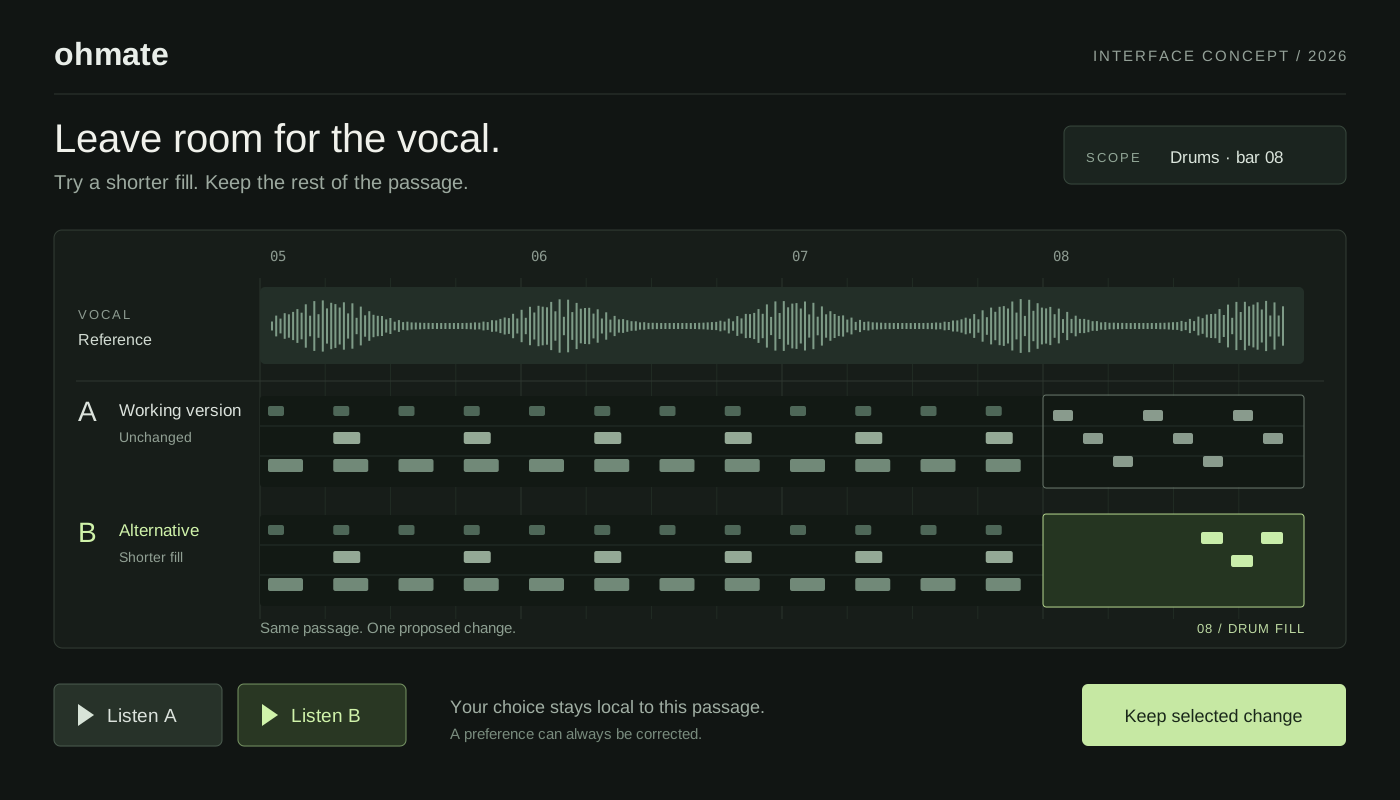
A producer may choose a shorter drum fill because a vocal is still going, because this particular song needs space, or because they simply prefer it today. Those choices can look identical in an interaction log. ohmate asks how an assistant could learn from musical work while keeping its interpretation open to correction.
Keep the working version intact
In the proposed workflow, A is the working project and B is an alternative prepared within a scope the creator has agreed to. The creator can compare them, keep selected changes, ask for another direction, or stop. Only the creator applies changes to A. Questions that help with the current musical task can happen during work; optional questions for learning about the creator wait until the task is finished.
Events, interpretations, and corrections
The design separates what happened, what the assistant thinks it means, and what the creator actually said. An undo is recorded without assuming a reason. A correction such as “leave space under this lead part” can apply to that musical situation without becoming a general preference. The record keeps the original choices even when an interpretation is withdrawn.
The paper and the next test
The public preprint includes a reproducible analytical example following compact and fuller fill choices across projects, an unexplained undo, and a scoped correction. It checks the behaviour of the proposed update rules. The integrated assistant has not been evaluated with users. The proposed evaluation would compare recommendations with and without personal history, then examine whether creators can find and correct mistaken interpretations. The conceptual paper is submitted to EAIM 2027.