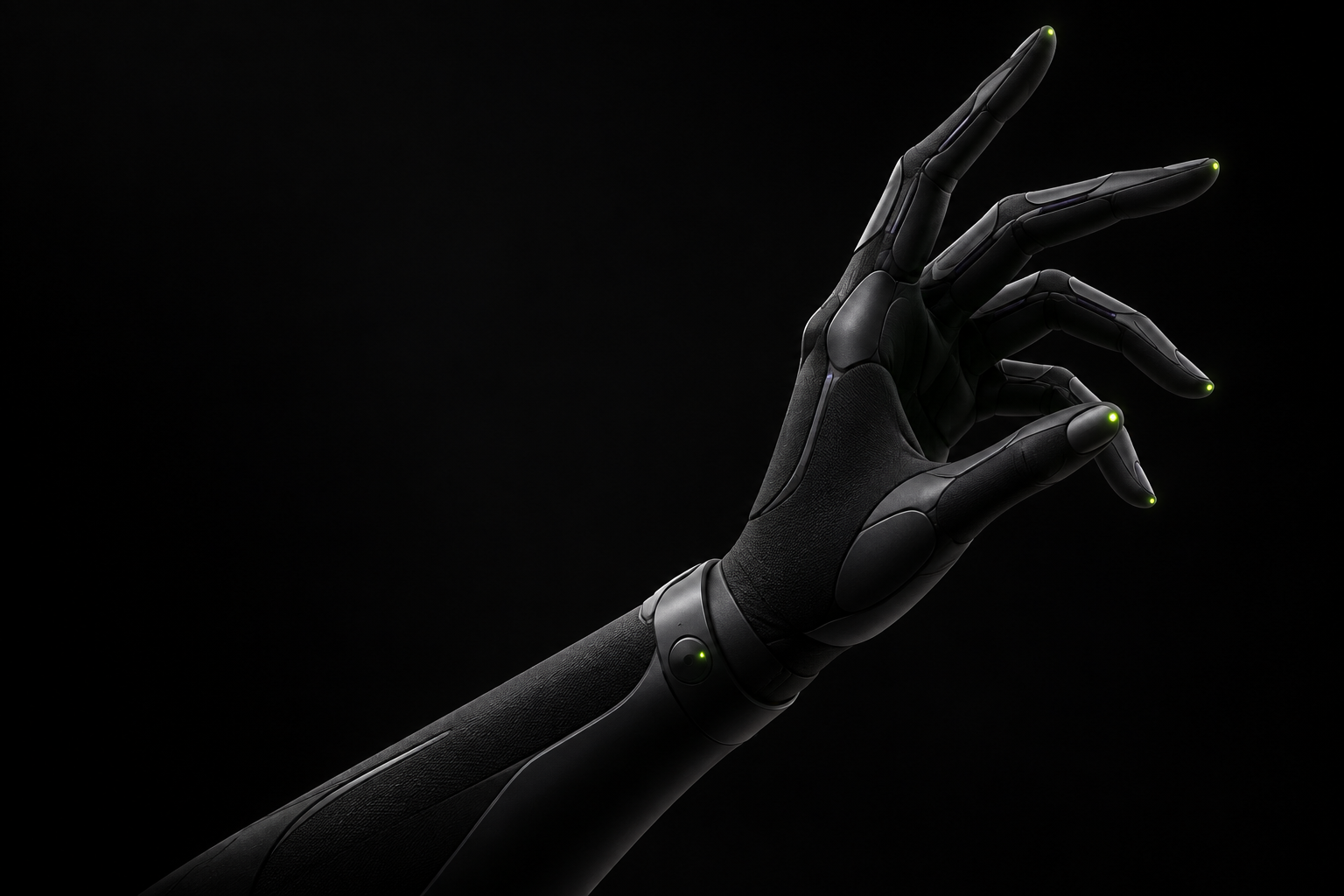
A controller that fits the player
Exoglove explores how a wearable musical controller can adapt to the person wearing it. Two people can make a similar gesture with different movement ranges, and a glove can sit differently each time it is put on. I am interested in what individual calibration changes in practice: how comfortably a player can reach a sound, hold it, and return to it.
From a gesture to sound
The prototype combines Bela sensor input, a Python calibration app on the Mac, and MIDI control in Logic. The hardware and software work covers finger flex, hand orientation, and touch. The app records calibration captures separately from control runs, then uses the captured movement to fit a personal mapping. Smoothing, output limits, and neutral-return behaviour help keep the control signal predictable.
The study I am preparing
The planned comparison includes a physical knob, a shared fixed glove mapping, and an individually calibrated mapping. I am starting with continuous control of a filter parameter so that the sound task stays comparable across conditions. Calibration time and removing and putting the glove on again are part of the question: a mapping needs to remain useful outside the session in which it was fitted.
Current work
I have calibrated two finger-sensor ranges on my own hand and revised how bending maps to a filter control in Logic. The Python and Bela pipeline also has software and MIDI-transport checks. These are prototype and bench results. The participant study is still in preparation; expressive control, learning, and reliability across players remain questions to test.